

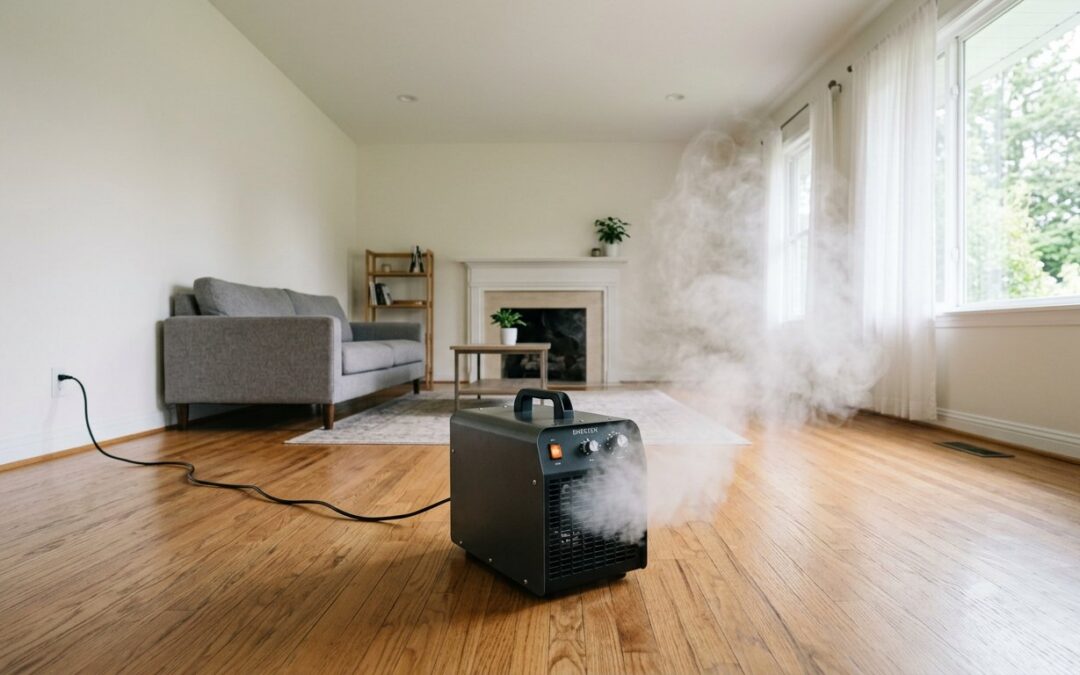
Masking a smoke odor never works — the smell just comes back. Real deodorization does not cover odor; it neutralizes it. Two of the most effective methods we use at Terry’s Cleaning & Restoration are ozone and thermal fogging. Here is how each works and when it is the right call.
Ozone treatment
Ozone (O3) is a highly reactive gas. When it contacts an odor molecule, the extra oxygen atom oxidizes and breaks it down, effectively destroying the smell rather than hiding it. Ozone is excellent for whole-room, enclosed-space odor — smoke, skunk, pet, and musty smells. Because ozone is a gas, it reaches air and surfaces that a spray cannot. The room must be unoccupied and sealed while treating.
Thermal fogging
Thermal fogging heats a deodorizing compound into a fine, dry fog whose particles are small enough to penetrate porous materials — walls, carpet, upholstery, and duct lining — where odor molecules have settled. Where ozone handles the air and open surfaces, thermal fog reaches into the fibers and pores. Combining the two is often the most thorough route for heavy smoke loss.
Which odors is each best for?
- Smoke odors — thermal fogging plus ozone gives the deepest result.
- Pet and skunk odors — ozone is strong; we pair it with a targeted treatment.
- Musty, damp odors — ozone helps, but the source (mold/moisture) must be dealt with or it returns.
- Tear gas and other difficult odors — ozone is a proven standby.
Deodorization is part of our specialty restoration service
We pair professional deodorization with structure cleaning and restoration so the odor is removed, not just treated. We also handle carpet, upholstery, air ducts, hardwood, and tile as part of the same mitigation. If a stubborn odor will not go away, call us at (574) 533-5626 — or learn more on our specialty restoration page.